
The following is an article version of Ricky’s message for Easter 2026. You can download a PDF version here.
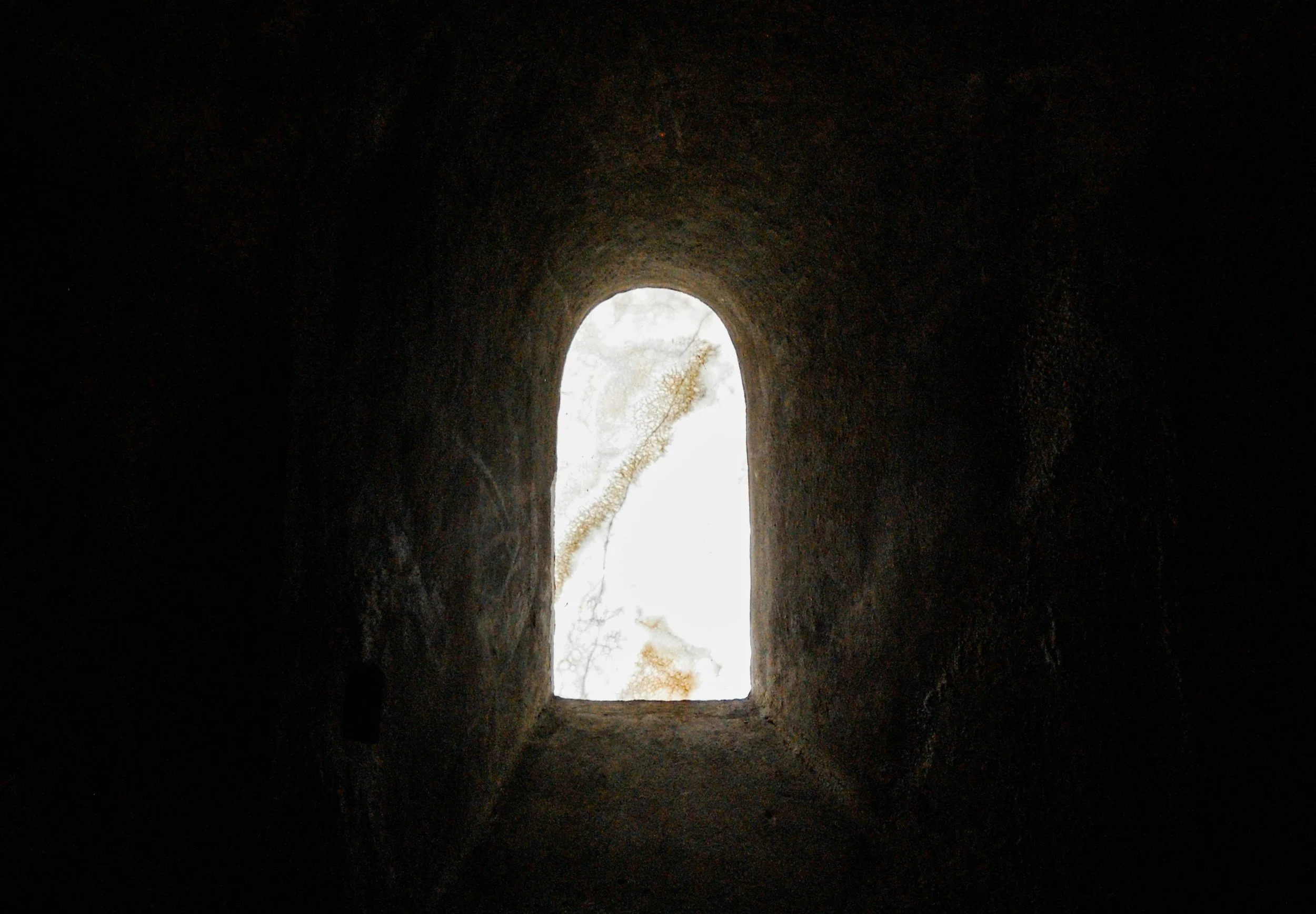
The Empty Tomb Answers
Two Questions We Bring to the Tomb, One the Tomb Asks Us
The Gospel of Mark is not a tidy book. It ends, famously, without resolution — the women flee the empty tomb, trembling and astonished, and say nothing to anyone. No appearance of the risen Christ. No triumphant closing scene. Just silence and fear and an open question hanging in the air.
And yet, for two thousand years, that unresolved ending has been the point.
Some well-meaning monk or church historian, apparently convinced that a proper gospel needed a proper ending, added additional material — verses that appear in many Bibles today, but with a marginal note acknowledging they were absent from the earliest manuscripts. The impulse is understandable. Open endings are uncomfortable. We want resolution.
But Mark's ending is not a mistake. It is an invitation.
The Gospel of Mark invites us to bring our own unresolved lives — our question marks, our losses, our failures, our doubts — to the empty tomb. Why did that happen to me? Or When will this be fixed? Or Is there hope for failures like me? We’re invited to bring those to the empty tomb. But when we arrive, we discover that the tomb has a question of its own for us.
I. What Is the Worst Thing That Has Ever Happened to You?
The Women at the Tomb
Consider the women who came to the tomb that first Easter morning.
When the Sabbath was past, Mary Magdalene, Mary the mother of James, and Salome bought spices, so that they might go and anoint him. And very early on the first day of the week, when the sun had risen, they went to the tomb. — Mark 16:1–2
They were coming to perform the final, sorrowful duty of love: to anoint a dead body before it decomposed. Three days had passed. The smell of death was already in the air.
These were women who had walked with Jesus through years of ministry. Mary Magdalene — a woman who had been used and broken by the world and then restored by Jesus — had staked everything on him. Mary the mother of James had welcomed him like a son, seen him welcomed at her table, watched her extended family expand around him. Together, they had witnessed miracles and listened to his teaching with astonishment. They had seen in Jesus the fulfillment of everything Israel had hoped for: a King who could deliver, restore, and save.
Now he was dead and decomposing in a tomb.
What is it that you carry to the empty tomb? What hope has collapsed, what dream has been buried, what loss has left you wondering how to go on? Bring it with you as we approach the tomb.
The Crack in the Foundation
These questions are like cracks that keep breaking into our lives no matter what we do. We experience real pain — genuine loss, genuine brokenness — and our first instinct is to cover it over. A new relationship, a new career, a change of scenery.
My wife and I nearly bought a house once with a major problem that had been hidden. We loved the house, but there was a strange paint job of jaggled patterns all over the walls. We learned later that the foundation was failing and that this paint job was hiding dozens of cracks over the walls and ceiling.
This is so often what we do in life. We paint over the cracks and tell ourselves the house is fine. The best that other religions can do is paper over the cracks of human experience, but no philosophy can fix the problem in humanity’s very foundation.
But Scripture refuses to let us settle for cosmetic repair. The Bible traces all suffering — every loss, every death, every broken relationship — back to a common root. As Paul writes:
Therefore, just as sin came into the world through one man, and death through sin, and so death spread to all men because all sinned. — Romans 5:12
In the opening chapters of Genesis, there is no death — only peace and flourishing. In Genesis 3, sickness and death and brokenness enter the world. Sin fractures our relationship with God, with one another, and with creation itself. The cracks run all the way to the foundation.
No amount of painting over them will reach that deep.
The Answer in the Empty Tomb
And then the women look up.
And looking up, they saw that the stone had been rolled back — it was very large. And entering the tomb, they saw a young man sitting on the right side, dressed in a white robe, and they were alarmed. And he said to them, "Do not be alarmed. You seek Jesus of Nazareth, who was crucified. He has risen; he is not here. See the place where they laid him." — Mark 16:4–6
The text is plain and unadorned: Jesus really died. The tomb was real. The burial cloths were there. And Jesus was not.
History has produced many remarkable religious figures — teachers, prophets, martyrs, founders of great movements. Only one has descended into the foundation of the world, gone all the way down into death itself, and come back out. Only one.
Centuries before the resurrection, the prophet Isaiah had spoken of a day when God would do something almost too large to comprehend:
He will swallow up death forever; and the Lord GOD will wipe away tears from all faces... It will be said on that day, "Behold, this is our God; we have waited for him, that he might save us." — Isaiah 25:7–8
That day arrived on Easter morning.
C.S. Lewis, in The Lion, the Witch and the Wardrobe, gave us one of the most memorable ways of putting it: because of the great sacrifice, "death itself starts working backwards." The resurrection of Jesus sets death running in reverse.
For all who trust in Christ, the losses of this life are not final. Hurts can be healed — now and forever. The dead will be raised. Paul puts it simply and staggeringly:
For as in Adam all die, so also in Christ shall all be made alive. — 1 Corinthians 15:22
"What is the worst thing that has ever happened to you?" The empty tomb answers: in Christ, even that is not beyond undoing.
II. What Is the Worst Thing You Have Ever Done?
The Disciples' Failure
The first question concerns what has been done to us. But the Gospel of Mark is not content to leave it there, because the truth about human beings runs deeper than victimhood. We are not only sinned against. We also sin.
Mark makes this point with almost brutal honesty. When Jesus is arrested, the disciples — the men who had traveled with him for three years, who had seen the miracles and heard the teaching and pledged their loyalty — flee into the darkness. Every one of them. Mark includes himself in this indictment, noting in chapter 14 that one young man fled so desperately that he left his cloak behind and ran naked into the night, exposed and ashamed. It is not a flattering detail. It is an honest one.
And then there is Peter.
Peter — the loudest voice, the most fervent pledge of loyalty, the one who said he would die before he denied Jesus — denies him three times. Not to a judge or a soldier. To a servant girl. The bravest of the disciples, the boldest, collapses in fear before a question from someone with no power over him at all.
The Weight of What We've Done
There is a kind of anonymous prank that used to make the rounds: someone would mail a letter to a stranger reading simply, "I know what you did. Soon everyone will know." The results were revealing. People confessed to hidden affairs. Others fled to other countries. Long-buried crimes resurfaced. The joke, if it could be called that, worked because it touched something universal: most of us are carrying something we would rather no one know.
Our instinct in moments like these is to find someone worse than ourselves and take comfort in the comparison. "At least I'm not like them." But this is a smaller comfort than it appears.
The weight of a wrong is not determined only by what was done, but by who was wronged. An offense against a stranger is one thing; an offense against a close friend is something else entirely. And if that is true — if the closeness of the relationship multiplies the weight of the wrong — then the most serious offense any human being can commit is not against another person, but against God himself. The One who created us. The One who loves us most.
When we see it in those terms, the disciples' failure stops looking like something distant and foreign. It begins to look very familiar.
"And Peter"
Here is where the Gospel of Mark does something astonishing. Having laid out the failure in full — the flight, the denials, the cowardice — the angel at the empty tomb delivers this message:
"But go, tell his disciples and Peter that he is going before you to Galilee. There you will see him, just as he told you." — Mark 16:7
Two words in particular deserve to be held in the light: and Peter.
Jesus does not say, "tell the disciples" — and leave Peter to wonder whether the invitation extends to him after what he has done. He singles Peter out by name. The worst offender, the one who should by any reckoning have forfeited his place — Jesus calls him back explicitly. Not to punishment. To restoration. To renewed relationship.
Peter would go on to help lead the early church. He would write portions of the New Testament. He would eventually give his life for the faith. How does such a story become possible after such a failure?
Peter himself gives the answer. Writing later to early Christians, he describes what made it possible:
...you were ransomed... with the precious blood of Christ, like that of a lamb without blemish or spot. — 1 Peter 1:18–19
The offense against God — the one no amount of effort or good intention can cover — was paid not by us, but by God himself. The debt was absorbed at the cross. And because it was fully paid, there is no sin and no guilt left outstanding for those who come to him.
There are many jokes I’ve heard about St. Peter at the pearly gates, but remember that it’s a miracle that Peter would find himself behind the gates at all. Imagine his record being reviewed – he couldn’t even stay awake to pray with Jesus, he so misunderstood Jesus’ mission he resorted to violence, then he was such a coward he denied Jesus. And then denied him again. And then again. How is that such a failure could find himself welcomed behind the “pearly gates” of heaven? How could a failure be restored?
Perhaps Peter’s answer would be simple: I was invited.
Mark 16:7 is the invitation: “And Peter.” Jesus, on the other side of the cross and empty tomb speaks not a word of judgment or condemnation, but a word of invitation.
That word of invitation — "and Peter" — is still being spoken. Whatever you have done, whatever you have hidden, whatever you are afraid cannot be forgiven: look again at the angel's message. Find your name there. The invitation has not expired.
III. Who Is Jesus to You?
The Question the Gospel Was Always Building Toward
Throughout the Gospel of Mark, a single question echoes again and again: Who is this? Who is this man who teaches with such authority, who heals the sick, who commands the wind and the waves? The question builds through chapter after chapter, demanding an answer.
Two answers arrive near the end. First, the Apostle Peter: "You are the Christ" — the Messiah, the promised King of Israel. Then, at the cross, a Roman centurion who has just watched Jesus die: "Surely this man was the Son of God." A Jewish disciple and a Roman soldier, arriving at the same conclusion.
He is the King. He is the Son of God. He is the Savior.
And that is why the empty tomb does not simply announce good news. It asks a question.
Evidence That Cannot Be Dismissed
For the original readers of Mark's gospel, the evidence was not merely historical — it was immediate. The names in the text were real names; the people could be located and questioned. And the evidence of ordinary men and women willing to die for what they had seen and heard was all around them. This was not mythology. It was testimony.
That testimony has not grown quieter over two thousand years. We have the manuscript evidence — the Gospel of Mark is among the most well-attested documents from the ancient world. We have the historical record of the early church, an unlikely movement that spread across cultures and continents with extraordinary speed. And we have, perhaps most powerfully, the ongoing evidence of lives changed: men and women across every language, culture, and century who have encountered the risen Jesus and been made new.
The question the empty tomb asks is not primarily academic. It is personal.
The Question Is Yours to Answer
It is possible to know a great deal about someone without knowing them. A biography gives us facts; it does not give us a relationship. The Gospel of Mark is not primarily offering information about Jesus. It is offering an encounter with him.
Perhaps you are reading this as someone for whom Jesus has always been a distant figure — a religious name, a historical footnote. The empty tomb confronts you with a decision. Who is this man to you?
Perhaps you once knew him, or thought you did, but you have drifted. You’ve wandered. You’ve looked up and found yourself far away. The invitation of Mark 16:7 is still extended: he goes before you. He is waiting.
Perhaps you grew up surrounded by faith — in a church, in a Christian family — and you know that the people around you know Jesus. But do you know Jesus?
The Gospel of Mark ends with an unresolved question precisely because it refuses to answer that question on your behalf. It brings you to the tomb. It shows you the stone has been rolled away. It gives you the testimony of those who saw what they saw.
And then it asks: Who do you say he is?
A Personal Word
At the empty tomb we find hope that continues to rippled out into the world. My wife and I are testimonies of this. Too often people assume that because I’m a pastor nothing bad must have happened to either of us, or assume that we’ve always been good nice people. Not so.
My wife Jenn grew up carrying tremendous loss. She was a twin who lost her sister at a young age, then lost another sister years later. Her home life was volatile and difficult. She buried so much of it, as people do. But as a teenager, she heard a message about heaven and something changed in her. She felt and understood in a profound way that because Jesus rose, she had the hope of heaven. The worst things are not final. They can be undone. That understanding has shaped her life ever since.
My own story runs along the second question. I appeared, from the outside, to be a good kid. But through my teenage years I was quietly living a double life, carrying patterns of sin I kept hidden from everyone around me. It finally came apart in my late teens, when I was serving in a Christian ministry and the whole truth surfaced. I had taken the trust of real people and broken it. I called my pastor. After he let me speak, the first thing he said was this: "Ricky, as you've repented, God forgives you. He loves you. He's for you." That moment changed me again.
So the empty tomb is not a monument to a past event. It is the source of life that is still flowing — into grief, into guilt, into doubt, into the ordinary brokenness of ordinary lives. Jesus has changed ours.
He can change yours too.
He has risen.
Mark 16:1–8 | Romans 5:12 | Isaiah 25:7–9 | 1 Corinthians 15:22 | 1 Peter 1:18–19